
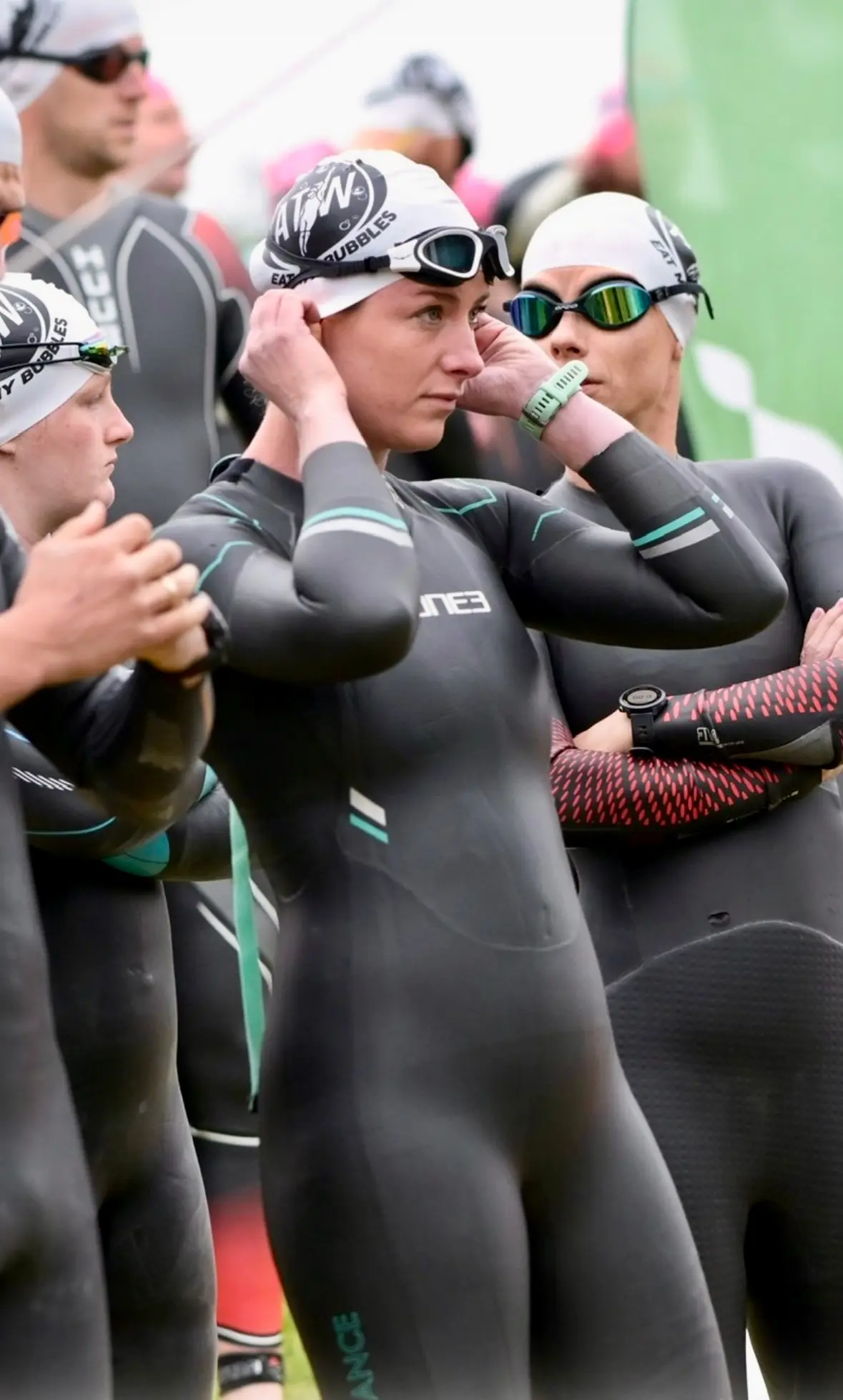
What to do when your mind and body go into overdrive before competition
Are competition nerves normal?
The short answer is yes!
You’ve been training consistently, putting the work in, and feeling good about where you’re at.
Then why, on competition day, does it feel like your mind and body are betraying you?
Your heart rate is ramping up. Your stomach is full of butterflies doing backflips. Your legs feel like they belong to someone else. You need four times more loo trips than normal. And your thoughts start going into overdrive:
“What if I mess up?”… “What if I’m not ready?”… “What if everyone else is better than me?”… “What if I let myself down?”
If any of this sounds familiar, I first want to reassure you that you’re not alone. In fact, I’d say pre-competition nerves are one of the most common topics that people talk about with me.
I’m yet to come across a sportsperson who doesn’t notice something different before a competition. And that includes myself! I’m a Sport Psychologist, but I’m also a triathlete; and I can still get a truckload of nerves delivered to me on race day, even though I didn’t order them. I’ve absolutely laid in bed at 5am on race morning, bargaining with myself about all the reasons I shouldn’t get up. And I can assure you that I’ve later headed to the race start feeling high as a kite on adrenaline – and believe me, it’s not a feeling I’d choose voluntarily!
Knowing the psychology behind nerves doesn’t make them disappear. But, and this is a big but: I actually don’t think that’s the goal. The more useful way of approaching competition anxiety for me has become:
“Can I make room for these nerves and still do what I came here to do?”
That’s the approach I use with athletes I work with, and I’m going to speak here to the why and the how.
Why do I get competition nerves?
Put simply, our brain often sees competition as different from training.
In competition, there is usually something at stake that’s meaningful to you: A result, a position, selection, a personal best, a team performance, or simply the feeling that you want to do yourself proud or your training justice. The thing is, our brains are highly attuned to notice anything that poses a threat to what matters to us.
I describe this to athletes as their brain’s “Danger Detector.” It’s a simple metaphor for some of the brain circuitry involved in detecting, interpreting and responding to potential threats in everyday life, as well as sport. Essentially, these systems work together to try to keep us safe.
It’s true that the Danger Detector can be incredibly helpful. If you touch something hot and quickly remove your hand, or you’re about to cross the road and a sudden speeding car makes you pause, that’s your Danger Detector at work.
But the Danger Detector can also misinterpret or exaggerate threats and then get trigger-happy when sounding the warning alarm. Remember that competition likely holds meaning to you, and so your Danger Detector will work hard to detect threats that could scupper your personal hopes and goals.
Physical threats might include: “What if I…. hurt myself… re-injure myself… injure someone else” or “This effort is going to be painful!”
Emotional threats might include: “What if I… fail… embarrass myself… let my coach down… mess this up in front of everyone… ruin my reputation… am disappointed by my result when I’ve worked my butt off for this”.
Your brain and body will often then respond to these perceived threats in a way that we tend to call ‘nerves’. Perhaps on competition day all you can think about or picture is what might go wrong. Or your body suddenly feels swamped by symptoms like tension, racing heart, shaky legs, tight chest, butterflies, or nausea. Your Danger Detector has hit the threat-detecting alarm, and your heart rate, breathing, muscle tension and attention are changing as your body prepares you to react to the perceived danger.
How can I get rid of competition nerves?
Spoiler alert: You don’t need to get rid of them (you can work with them).
Most people say to me their nerves feel uncomfortable, and so it’s very understandable that our first instinct is to try to get rid of them.
“I need to get rid of my nerves”, or “I can only perform well when I’m calm” are words I often hear.
But this is where things can get tricky. Because when you make eliminating nerves a requirement for performing well, you can end up spending precious time and energy fighting them rather than getting on with your performance. And in any case, the energy and alertness that come with ‘nerves’ can potentially be useful for your performance, depending on your sport and role. Would you really want to start your race/game/event feeling as chilled as if you were lying on the sofa watching Traitors?
Trying to get rid of nerves can also mean you end up monitoring yourself constantly:
“Am I calm yet?”… “Why is my chest still so tight?”… “I shouldn’t be feeling this nervous”… “Everyone else looks confident, but I’m bricking it”.
Now you’re not only dealing with the original nerves; you’re also fighting with the fact that you’re nervous. This is what I call a snowball effect: You’re feeling more nervous because you’re stressing about feeling nervous!
One of the main therapeutic approaches I use as a Sport Psychologist is called Acceptance and Commitment Therapy (ACT). Rather than fighting nerves and aiming to ‘feel calm’ as a condition to perform well, ACT takes a different perspective. An ACT approach suggests that we can learn to notice nerves – without automatically trying to control or eliminate them – and then choose how we want to respond.
So, how can I perform well despite feeling nervous?
My ABCD approach to competition nerves.
One of the ways I help athletes work with competition nerves is through a simple ABCD approach. You won’t find this in a textbook, and it’s not its own ‘theory’: it’s my way of packaging some evidence-based ACT-informed ideas into something memorable and practical that you can actually use.
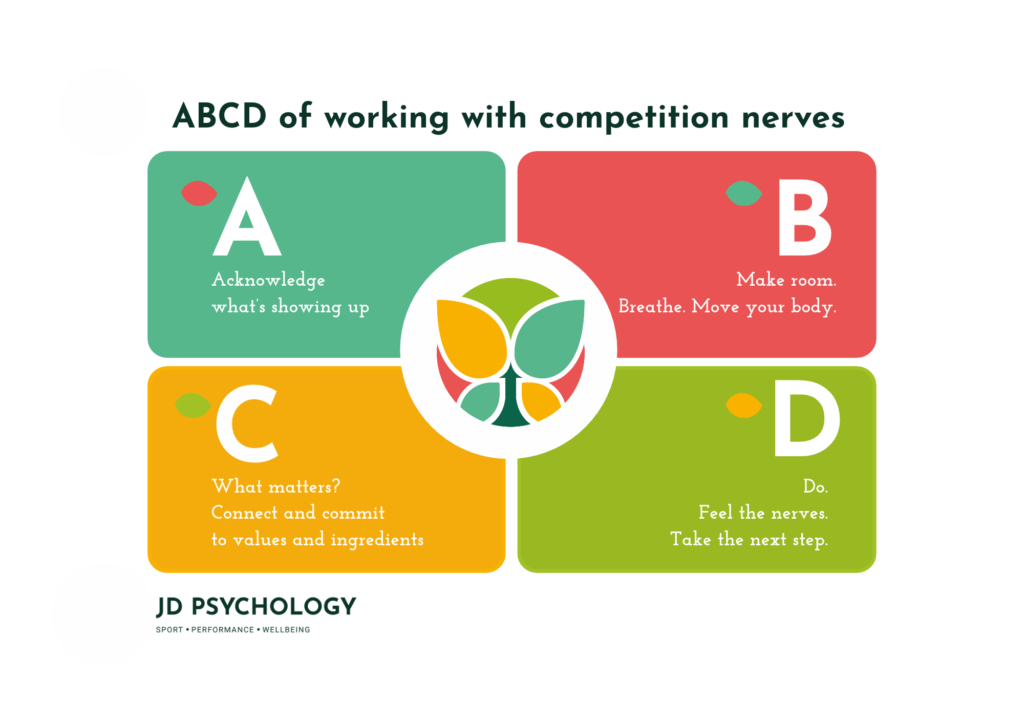
A: Acknowledge
Can you get curious about what the nervous thought or feeling is really like?
First, notice what’s happening. Aim to be curious about the nervous thought or feeling showing up, rather than judging yourself or immediately trying to change it.
With tricky thoughts (like “What if…” worries or an image of things going wrong): Try acknowledging them in a neutral way:
“Ah, there’s my Danger Detector doing its job”… “Interesting thought, mind”… “Yep, thanks Danger Detector”.
Notice how we’re not looking to argue with the Danger Detector. We’re just seeing it as one perspective in this moment, rather than a truth, fact, or forecast. It could have a point, after all: You might get hurt, or your competition may not go to plan. But remember that the Danger Detector can also take its job too seriously and it isn’t perfect. It can be inaccurate, exaggerate the dangers, and sometimes hit the alarm when it’s not needed.
Note that you don’t need to be restricted to the name “Danger Detector”. Lots of people I work with get creative when naming their threat-detecting brain circuitry: from “Protector”, “Alerter”, or “Mr/Mrs Health & Safety” to a human name like “Brian” or “Negative Nelly”.
It’s a small change, yet it’s designed to remind you that a nervous thought is just a thought – something your mind is producing – not a prediction or instruction that you have to follow.
With tricky physical feelings: Again, trial acknowledging them in a neutral way:
Where is the feeling in your body? What size or shape is it? Is it heavy or light? Still or moving? What colour would it be?
These questions sound a bit daft, but they’re designed to help you see a nervous feeling a bit differently. It’s amazing how quickly people I work with shift from something like “that awful nervous feeling taking over”, to “Heavy cool grey rocks flipping in my stomach”, or “light aqua cold bubbles whooshing up and down my arms and legs that give me goosebumps”.
You don’t have to love your “rock” or “bubble” feeling (or whatever you observe). But notice how a nervous feeling is just one experience happening in your body right now – it isn’t all of you. It might be in your belly, or your chest, or your legs… and you can practise noticing it without letting it dictate what you do next.
You can also experiment with relabelling your “rock” or “bubble” feeling as your “performance state” or “competition mode”. Whilst it may be uncomfortable, a nervous feeling isn’t ‘bad’ per se. As we identified, the feeling of nerves (or “performance state”) reflects physiological changes, like increased alertness and energy, that sometimes may even be useful for performance.
So, you’ve noticed nervous thoughts and feelings in a different way, knowing that they don’t have to disappear to perform well. What next?
B: Breathe & Body
Check in with your breath and your body: What can you do, even with the nerves?
Keep this in mind: You – and your body – are bigger than a tricky thought or feeling. There’s room for nerves, and for you to breathe, move, shift attention, act and perform. Be curious about what you can still do, if you were to ‘make room’ for nerves:
You can connect with your breath. Take a few slower, deeper breaths. In through your nose, and a long steady breath out through your mouth. Imagine drawing that air down towards your belly button… and all the way out again. And repeat. Notice how, however intense your nerves, you can influence the pace and depth of your breath.
You can move or stretch your body. Can you roll your shoulders… push your feet into the ground… wiggle your fingers or toes… talk or smile? Then, you are still here, in the here and now, and able to choose what you do next. Try moving whatever part of your body feels good in that moment. Perhaps that’s a gentle stretch to release tension a couple of hours out from your event. Perhaps it’s something more dynamic like a tuck jump or bouncing on your feet just before you begin.
Connecting with breath and body is a great way to bring yourself back into the here-and-now and feel grounded, given that Danger Detectors love to freewheel into the future. It’s not a magic switch to make nerves disappear. It’s a way to show yourself that you can still breathe, move, and do – and that you’re also capable of taking the next step.
C: Connect & Commit
Connect to what you can take care of, then commit to it.
This is where you bring your attention back to what matters to you, and what you can genuinely take care of in your performance.
The Danger Detector will often pull your attention towards the future worst-case scenarios and ‘uncontrollables’, such as losing, mistakes, or what others think. Instead, two things I often suggest checking in with are: ‘Values’ and ‘Ingredients’. These two areas deserve their own blog, but here they are in a nutshell:
Values: What character qualities do you want to bring to, take pride in, and be known for, in your performance?
This could be: brave… disciplined… committed… adventurous… focused… patient… fun… resilient… passionate… driven… connected… proactive… consistent… or something else (no right or wrong, it’s what matters to you).
Try picking 1 or 2 values to move towards across your competition. They’re not something to achieve outright or tick off; more qualities you can keep choosing to bring to your performance. Values become a guiding compass for your actions in any given moment. So, whether you’re an hour out from your performance or struggling in the middle of a distance event: “What would the brave, driven me do now?” [insert your values] becomes an incredibly helpful question to bring you back to something you can take care of in that moment.
Ingredients: What aspects of your performance can you readily take care of?
Let’s face it, outcomes like winning, podiuming, a PB, all depend on factors beyond just you: the conditions, your competitors, everything coming together on the day – you’re not a robot! So, setting goals only around the outcome (like ‘qualifying’ or ‘selection’) can make you feel more nervous, because it’s a very pass-or-fail type of goal that’s not truly under your control.
Try picking 1 to 3 ingredients of your performance to focus on. These are skill- or tactical-based ingredients that help you move towards your desired performance. So, imagine I’m competing at a triathlon with an outcome goal to qualify for Europeans, and therefore need to place well against my opponents. If I leave my goals there, my Danger Detector will likely have a field day worrying about my opponents – their form, their times, how I’ll stack up – because I can’t control that stuff. Instead, I’ll focus on a few ingredients I can put my confidence and commitment into throughout my race, such as: “high elbow in my catch” in the swim, or “Power out of every corner and hill” on the bike. I’m committing to ingredients I can take care of in my race, and in turn I’m stacking the odds in my favour of the outcome I want.
D — Do
You can feel nervous and still take action.
Finally, it’s about taking the next step of your prep, warm-up, or performance.
Often as humans, we wait to feel ‘ready’ – yet we’ve already interpreted nerves as a waving red flag that says we’re not. Remember that nerves are an experience you’re having, not an instruction you have to follow or a sign you can’t do something.
This is a mindset shift I think is particularly important. You don’t have to wait until you feel confident, or calm, or until the nerves disappear. You can feel nervous and do it anyway. That might mean stepping onto the football pitch, riding into the ring, getting onto the start line, tackling that gymnastics skill, or committing to the next point.
With your values and/or ingredients in mind, the final step is simple: trust yourself to DO. Your nerves can come along for the ride.
Could we work on this together?
Of course. If competition nerves are getting in the way of your enjoyment or performance, sport psychology sessions can give you space to understand your experiences and develop ways of responding – like the ABCD approach – that are tailored to you. Our goal won’t be to turn you into someone who never gets nervous, but to help you respond to your nerves in a way that frees up mental space for your actual performance.
You can find out more about working with me HERE and you can contact me HERE.